

Artificial intelligence (AI) is now everywhere, and the patent system is no exception. AI is already used in prior-art search, document review, drafting assistance, examiner workflows, patent analytics, and even invention creation. In other words, AI is no longer just a subject of patenting. It is becoming part of the machinery of patenting itself.
Reframing the debate
The question that has attracted the most attention from scholars and the media alike is whether AI can be named as an inventor, pushed most prominently by Ryan Abbott’s Artificial Inventor Project. Under current law in the major systems, the answer remains largely no. The EPO’s DABUS decision states that a machine is not an inventor within the meaning of the European Patent Convention. The UK Supreme Court held that the statute requires a person to be named as inventor. And the USPTO’s current guidance similarly states that only natural persons can be inventors.
This legal question matters. It tells us what current statutes can bear without legislative change. But I have long held the view that the public debate about AI and patents began in the wrong place. AI affects the invention process itself and, therefore, the very incentive structure that patents are meant to shape. Once that premise is accepted, the most important question from an economic viewpoint is not whether an AI system can be named as an inventor. It is whether society should want patents for AI-generated inventions at all—and, if the answer is yes only in part, how the patent system should adapt.
The economic case for allowing patents on AI-generated inventions
The most powerful argument against patents on AI-generated inventions is that AI is likely to sharply reduce the cost of generating candidate inventions. Once inventions become cheap and scalable, traditional patent rewards can start to look like overcompensation. At some point, granting a full patent for an AI-generated invention begins to look like a windfall rather than a necessary incentive. If so, the patent system would no longer induce additional invention; it would simply be granting broad exclusionary rights over outputs that would have appeared anyway—precisely the type of inventions for which we do not want to give patent protection.
However, even if the cost of generating an idea falls dramatically, the cost of turning that idea into a product often remains very high. In capital-intensive sectors such as pharmaceuticals, biotechnology, medical devices, and advanced materials, the initial discovery of a candidate molecule, design, or material is only the first step in a long chain that includes testing, optimization, scale-up, regulatory work, and commercialization.
That downstream logic is especially important because the free-rider problem does not vanish when AI makes discovery cheaper. If a firm bears the downstream development cost while rivals can copy the successful result once uncertainty has been resolved, then underinvestment in commercialization remains a genuine risk. In an article with Adam Jaffe and Melisa Wasserman, we argue that patents on AI-generated inventions are not primarily about rewarding the creative spark; they are about protecting the costly path from a candidate invention to a marketable product.
A second economic argument is disclosure. The patent system operates on a quid pro quo bargain: society grants a temporary monopoly in exchange for a complete, public disclosure of the technical knowledge. Enrico Bonadio and colleagues point out that, if patent offices categorically refuse to protect AI-generated inventions, companies will not stop using AI; instead, they will stop disclosing their discoveries. This transition toward secrecy would hamper technological progress. It would limit the diffusion of scientific knowledge, prevent follow-on innovators from building upon the state of the art, and force multiple corporate entities to wastefully duplicate research efforts to solve the same technological problems.
A third argument, highlighted, among others, by Peter Picht and Florent Thouvenin, concerns technology transfer. Patents convert technical outputs into legally tradable assets. They can be licensed, sold, cross-licensed, or used to structure collaboration between actors who specialize in different parts of the innovation chain. That function may become even more important if AI deepens the division of labor between discovery and commercialization—for example, between firms that are good at algorithmic search and firms that are good at clinical development, scale-up, or distribution.
In short, the key pro-patent claim is conditional rather than absolute. Patents on AI-generated inventions are easier to justify where downstream investment is costly, risky, and socially valuable; where disclosure creates meaningful spillovers; and where markets for technology help inventions reach those best placed to commercialize them.
The economic case against
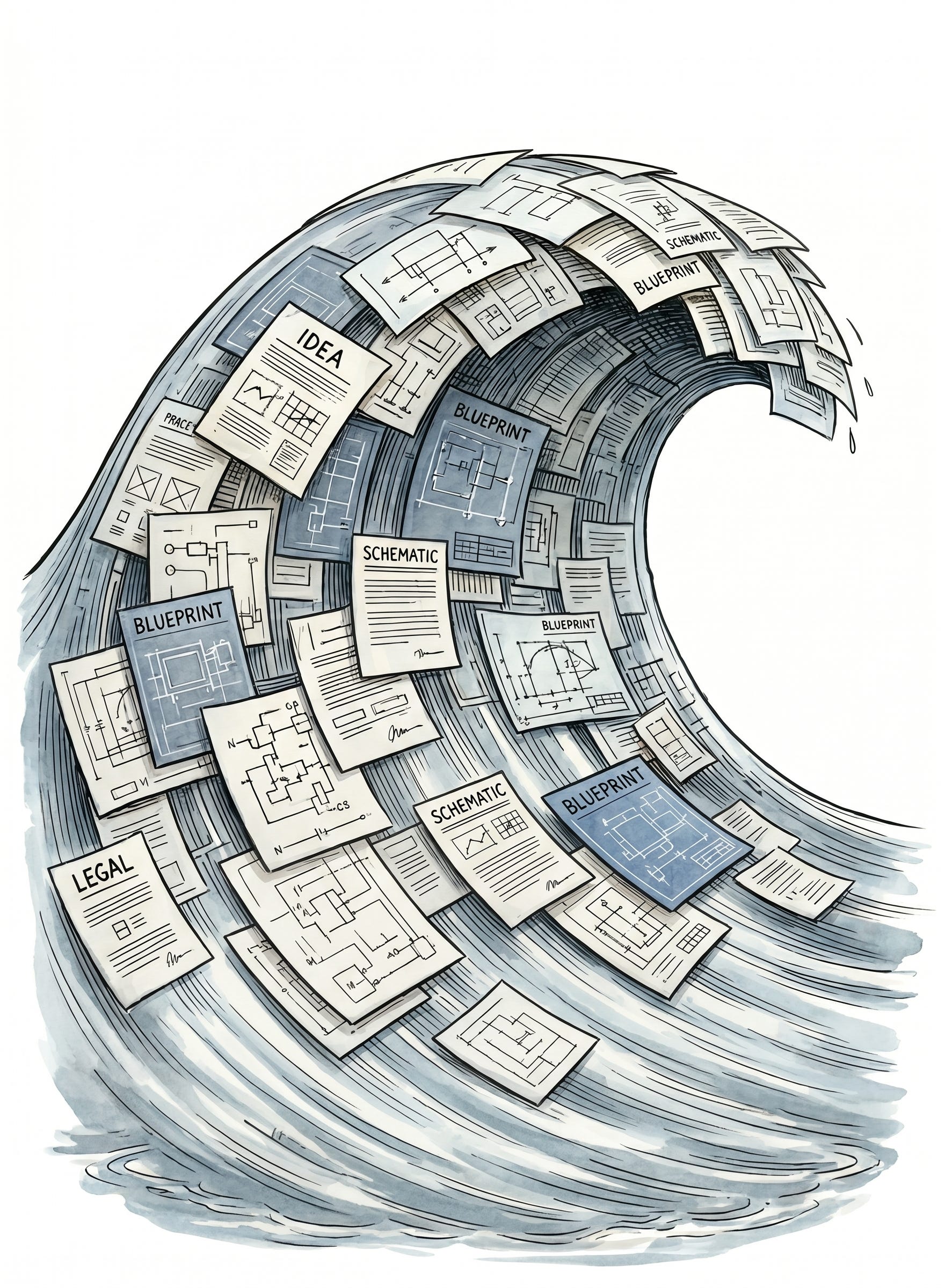
The drastic reduction in the costs of producing inventions also threatens to trigger an administrative crisis within the patent system. Because AI systems do not tire, a single corporation utilizing automated pipelines could generate and file thousands of patent applications per week [1]. This would lead to a massive volume of filings, overwhelming patent offices, and causing severe examination delays.
The consequences are not merely administrative. Cheap invention plus cheap drafting can allow well-resourced firms to assemble very large portfolios, build dense patent thickets, and intensify the concentration of patent ownership. These thickets dramatically increase transaction costs, make it prohibitively expensive for new entrants to clear patent rights, increase litigation risk, and potentially shut down competitive market entry. IP Australia warns that a new genre of “patent trolls [… can …] rapidly create a multitude of patent specifications crowding particular technology areas or industries.”
There is also a deeper economic problem. If upstream AI outputs are easy to patent, follow-on innovators may have to negotiate through a fragmented maze of rights over building blocks, intermediate solutions, and near-adjacent variants. That is the familiar tragedy of the anticommons, but AI could make it much worse by vastly expanding the number of potentially claimable components. Future researchers would need to navigate a legal minefield, increasing R&D costs and effectively blocking downstream development.
Finally, the traditional patent bargain of exclusion in exchange for disclosure may break down entirely under the weight of AI-assisted drafting, as argued among others by Tabrez Ebrahim. Generative AI tools can draft highly detailed, credible, and legally compliant patent specifications. However, from a scientific perspective, these automated drafts may contain incorrect, misleading, or entirely unworkable details for hypothetical or unsolved technical problems. This frictionless generation of plausible-sounding fiction threatens to pollute the patent ecosystem with the exact same phenomenon currently choking academic publishing—a systemic degradation of data integrity that researchers have aptly dubbed “AI slop.”
Because patent examiners are under tight time constraints, they are unlikely to detect these subtle, “credible but defective” scientific and technical errors. Lisa Ouellette and colleagues explain that patent offices risk granting patents that fail to teach the public how to practice the invention. Conversely, these defective, AI-generated documents enter the public record as prior art, allowing patent offices to improperly deny patents to genuine human inventors whose workable solutions are deemed obvious in light of earlier, unworkable machine-drafted text.
Some possible evolutions of the patent system
To navigate these competing forces, economists and legal scholars have proposed several systemic reforms. These middle-ground solutions aim to adapt the patent system to the realities of automated inventions without completely dismantling intellectual property protection.
A first, oft-discussed reform is an AI-augmented obviousness standard [2,3,4]. To receive a patent, an invention must not be obvious to a Person Having Ordinary Skill in the Art (PHOSITA) at the time of filing. Historically, this legal fiction represented a human engineer with standard academic training and access to conventional tools. The integration of AI into corporate research labs has thrown this standard into crisis. If AI tools are routinely used by standard researchers in a given field, scholars argue that the legal definition of the PHOSITA must evolve to reflect an AI-augmented researcher. One immediate consequence of this adjustment is that, when the baseline of “ordinary skill” is upgraded to include a researcher equipped with state-of-the-art AI systems, the threshold for what is considered non-obvious rises. This adjustment would raise the inventive step threshold, ensuring that 20-year patent monopolies are reserved exclusively for genuine breakthroughs that exceed the predictive capabilities of standard machine learning tools.
That move may appear attractive, but it creates a severe paradox for small inventors. A higher AI-augmented baseline may preserve the patent system from a flood of trivial machine outputs, yet it may also disadvantage smaller firms and individual inventors who do not have access to frontier models, data, or compute. In that sense, a formally neutral standard could embed a very non-neutral industrial reality. That distributive concern deserves more explicit attention than it has usually received.
A second reform is stricter requirements for enablement and validation. As discussed, AI excels at generating plausible candidates and broad-claim language. It is (at least currently) less good at making those candidates real, reproducible, and fully characterized. Black-box systems, training-data dependence, and probabilistic model behavior can make written description and enablement harder. Both Lisa Ouellette and colleagues and Arti Rai have argued that patent offices should require more evidence that the applicant can enable the claimed invention, particularly when claims are broad and experimental validation is expensive [5,6]. This measure would prevent speculative land grabs.
A related possibility is to require structured traceability for applications that rely heavily on AI systems. Applicants utilizing AI tools could be required to submit a “Computational Traceability Report” [7]. This report would disclose the human choices that shaped the inventive process: problem formulation, key prompts, curation decisions, validation steps, and the relationship between AI outputs and the final claims. A traceability requirement would turn that logic into a more systematic evidentiary discipline
A third reform is fee design. As explained in a previous post, patent fees are one of the quietest but most powerful policy levers in the system. If the worry is not invention as such but brute-force bulk filing, then the most targeted response may be economic rather than doctrinal: higher excess-claim fees, steeper continuation costs, portfolio-sensitive fee schedules, or more aggressively rising renewal fees.
A final reform is the most radical: a narrower, shorter, or otherwise differentiated right for clearly machine-generated output, or even a sui generis regime, as advocated, for instance, by Alexandra George and Toby Walsh. The attraction is obvious. If AI reduces the need for classical invention incentives but leaves some case for disclosure or commercialization incentives, then a lighter right may be a better fit than a full patent. Yet the problems are also obvious. A differentiated patent system is easy to game, politically difficult to calibrate, and potentially awkward under international obligations.
Recalibrating the patent bargain
The integration of AI into the innovation pipeline is one of the most important challenges the patent system has faced in a long time. For more than two centuries, patent law has been organized around a simple intuition: the scarce bottleneck was human conception. It was costly to come up with new and useful ideas, so society offered limited exclusivity in exchange for disclosure.
If invention itself becomes cheaper, more scalable, and in some cases partially automated, then the bottlenecks move downstream. Scarcity may increasingly lie in data curation, model building, experimental validation, regulatory approval, manufacturing scale-up, and market entry rather than in raw ideation alone. That shift does not mean patents become irrelevant. It means the old justification cannot simply be repeated by reflex. Patent law must ask, with more precision than before, exactly which activity it is trying to encourage and at what social cost.
It is too simplistic to say that AI-generated inventions should be patented, since innovation needs incentives. It is also too simple to say that AI-generated inventions should never be patented because machines need no rewards. The harder—and more useful—question is which institutional adjustments preserve disclosure, commercialization, and technology transfer without allowing a flood of cheap exclusion rights to overwhelm the system. Patent offices are already beginning to confront that question in their guidance, consultations, and policy toolkits. The economic literature needs to keep pace with technological advances.
If you enjoy evidence-based takes on patents and innovation, join hundreds of readers who receive The Patentist directly in their inbox.
Please cite this post as follows:
de Rassenfosse, G. (2026). Patents after the invention machine. The Patentist Living Literature Review 13: 1–6. DOI: TBC.
That’s an interesting, incisive and well thought out article with a number of considered approaches to an issue that doesn’t get much attention.
Unfortunately, however, I fear the answer is none of the above.
I have thought about this a lot. I’m a big proponent of AI and we have used it a lot to develop systems that make us very efficient. I have worked with very bright people patenting genuinely clever AI technology that enables some of the advances. I’m a great believer in the value of the patent system in general to small and large businesses and have been involved in obtaining grant of about 5000 patents in my career. I enjoy opposing invalid patents and am not a fan of bad patents becoming a burden and have been involved in knocking out or limiting hundreds of patents.
And my conclusion, so far, from all of that direct and positive experience and genuinely thinking long and hard about it and chewing the fat with my similarly experienced colleagues who like to find solutions to tricky problems is… er, we’re doomed.
I just can’t think of any solution that doesn’t inevitably have unintended consequences either in principle or in the way it will undoubtedly be (a) imperfectly implemented and (b) gamed (possibly even by cynical people like me using AI to advantage for their clients). It makes it an intractable problem of whackamole.
I think we’re not far apart in that assessment.
The subtle difference is the most considered response I have come up with is to make the most of using bespoke AI tools to help me and my colleagues get what we need to get our clients patents faster and more effectively or oppose more effectively and enjoy the ride until the intrusion of AI in all other areas of life including the general erosion of democracies bring about a human catastrophe that makes a little dysfunction in the IP system seem somewhat less important.
Have a beer. Ride a motorcycle. Get a few more patents granted while you can. Anything else is likely to be futile and lead to frustration.
Hope my somewhat flippant or fatalistic response to a genuine issue is taken in the spirit intended.
But if you do persuade me you have a practical viable solution I will (a) buy you a beer and (b) sincerely lend my full support and try to mobilise my many friends in the industry to do likewise.