

Patent fees are usually treated as a dull administrative detail—a line item in a legal budget or a necessary friction for maintaining a patent portfolio. But in 2025, a reported U.S. proposal to charge patent owners a fee equal to 1–5% of the assessed value of their patents briefly turned these seemingly mundane charges into front-page innovation policy.
The proposal suggested that blockbuster patents worth billions should contribute more to the system than niche consumer inventions. By February 2026, the idea appeared dead, with Commerce Secretary Howard Lutnick telling a Senate panel that the USPTO would not pursue a valuation-based fee. Yet, even if the “value tax” was transient, the controversy revealed a deeper truth: patent fees are not merely a way to fund an office. They are a regulatory technology. They determine who enters the system, what gets examined, which patents survive, how patent offices behave, and, ultimately, who bears the cost of exclusive rights.
The applicant’s calculation: when fees change strategy
To understand how fees function as regulation, it is helpful to start by examining how inventors respond to price signals. In the economic literature, this response is measured by the price elasticity of demand.
A useful empirical rule of thumb is that a 10% increase in patent fees reduces patenting by roughly 3–5% [1,2]. For context, such a figure is closer to the price sensitivity observed for essential inputs such as oil or steel than for discretionary services such as leisure air travel, where a 10% price increase may reduce demand by more than 10%. In economic terms, patent demand is, therefore, relatively price-inelastic. Most applicants with a promising invention will not abandon patenting simply because official fees rise: the patent may be too important to the firm’s business strategy, fundraising prospects, licensing plans, or competitive position.
Low sensitivity to fees does not mean that fees are irrelevant. However, it implies that fee changes may need to be substantial before they produce visible effects. Historical evidence from Britain points in this direction. Tom Nicholas examines the Patents Act of 1883, which reduced the cost of patenting by a whopping 84%. The reform produced a large increase in patenting, but not a commensurate increase in measured innovation. The lesson is important: lower fees may induce greater use of the patent system without necessarily creating more inventions.
Furthermore, patent-office fees are not a single price, and applicants often respond along margins other than a simple yes-or-no decision on patenting. Fees are a schedule of charges for different choices, including, but not limited to, filing, examination, claims, continuations, disclosures, opposition, validation, and renewal. Instead of filing fewer applications, sophisticated applicants may adjust their filing strategies in response to a fee increase. The USPTO’s fee schedule, which saw major updates take effect on January 19, 2025, illustrates this kind of behavioral nudging. By introducing tiered surcharges for large Information Disclosure Statements (IDS), with fees rising as the cumulative number of submitted references crosses specified thresholds, the Office is seeking to discourage applicants from flooding examiners with prior art—not to discourage patent filings.
The IDS surcharge is an example of a “complexity tax”: a fee designed to make applicants internalize some of the administrative burden they create. Another example is the EPO’s 2008 introduction of a €200 claim-based fee for applications exceeding 15 claims, aimed at limiting excessive claim proliferation. More broadly, as Dietmar Harhoff and colleagues show, fees determine not only whether and how an invention is patented, but also where it is patented. In the fragmented European landscape, validation and translation costs force firms to make cold calculations about which national markets truly justify the “entry fee.”
Attorney fees set the gate; official fees steer the path
There is, however, an elephant in the room. Patent-office fees are only the visible, public part of the cost of patenting. For many applicants, they are not even the largest part. As innovators know, patenting costs include internal management costs, translation fees, patent attorney or agent fees, and administrative fees, with professional fees often dwarfing the fees charged by patent offices.
At first glance, the high patenting costs seem to weaken the case for the fee policy. If administrative fees are only a small share of the total cost of patenting, why should they affect behavior at all? The answer is that patenting decisions are not made once and for all. They are made sequentially at each procedural step, and many of those steps are governed directly by official fees.
The intuition is simple. Imagine that a firm has already paid a patent attorney to understand the invention, draft the specification, formulate the claims, and file the application. Much of that expense is now sunk: it cannot be recovered by abandoning the application. The relevant decision is no longer whether to incur the entire cost of patenting from scratch. It is whether the next step is worth paying for.
That next step may be filing a continuation, validating the patent in Greece or Belgium, responding to another office action, or paying the next renewal fee. These are marginal choices. They are often triggered directly by official fee schedules, even though the original attorney cost was much larger.
This distinction also varies by applicant type. Large firms with internal IP departments may draft applications in-house, standardize prosecution workflows, and spread fixed legal costs over large portfolios. For them, patenting may look more like an internal production process, with official fees becoming a more sizeable cost of portfolio management. By contrast, startups, universities, and independent inventors often rely on external counsel. For them, the first attorney bill may be the true barrier to entry.
Fees as a screening device: separating high value from low
If complexity fees shape how applicants draft and prosecute patents, application fees raise a more basic question: can the patent office use price to screen what enters the system in the first place? In principle, yes. A filing fee forces applicants to compare the expected value of protection with the cost of obtaining it.
Theoretical models by Bernard Caillaud and Anne Duchêne [3] and Florian Schuett [4] show how fees can induce self-selection. If applying is cheap, firms with marginal inventions may enter the system in the hope of obtaining protection. If application fees are higher, some low-value or obvious inventions no longer justify the cost of filing. Combined with meaningful examination, fees can therefore help create a separating equilibrium: stronger inventions are filed, while weaker ones are screened out before reaching the examiner’s desk.
Empirical evidence supports this screening logic, but with nuance. Studying the 1982 U.S. fee increase, one of my papers with Adam Jaffe finds that higher fees disproportionately weeded out patents in the lowest quality and value deciles. The effect, however, was concentrated among firms with medium-to-large portfolios, suggesting that fees screen most effectively where applicants already patent strategically.
Evidence from Japan reaches a similar conclusion from the opposite direction. Masayo Kani and Yoichiro Nishimura study Japan’s 2011 reduction in patent examination fees and find only a limited negative effect on the quality of patent applications, with no detectable decline in the quality of granted patents. Fee reductions may, therefore, widen access without necessarily flooding the system with low-quality granted patents, especially when examination remains meaningful. In this sense, the best way to ensure high-quality patents is to conduct high-quality examinations.
Access, inequality, and the small entity
The screening logic has an obvious distributional limit. Fees may discipline overuse, but they can also exclude applicants who lack cash, experience, or access to patent counsel. If fees are a regulatory technology, they must be calibrated not only to discourage weak filings, but also to preserve entry. For small firms, a discount may lower the toll charged by the patent office, but it does not eliminate the cost of crossing the bridge.
Recent policy shifts acknowledge that tiered pricing is part of innovation policy. The USPTO recently expanded discounts for small and micro entities under the Unleashing American Innovators Act framework. Similarly, in April 2024, the EPO introduced a support scheme giving qualifying micro-entities a 30% reduction in main procedural fees.
But the evidence also warns against expecting too much from fee reductions alone. In another paper with Adam Jaffe, we study whether lower application fees increase entry into patenting by small and micro entities. Their conclusion is sobering: fee reductions alone appear insufficient to significantly increase participation in the patent system among these applicants. The reason is precisely the broader cost structure discussed above. Official fees are only one part of the total cost of patenting; attorney fees, uncertainty, prosecution complexity, and limited familiarity with the patent system may matter just as much, and sometimes more.
This does not mean that small- and micro-entity discounts are useless. It means they are incomplete. They lower one barrier, but they do not transform the broader economics of access to the patent system.
The renewal test: which patents survive?
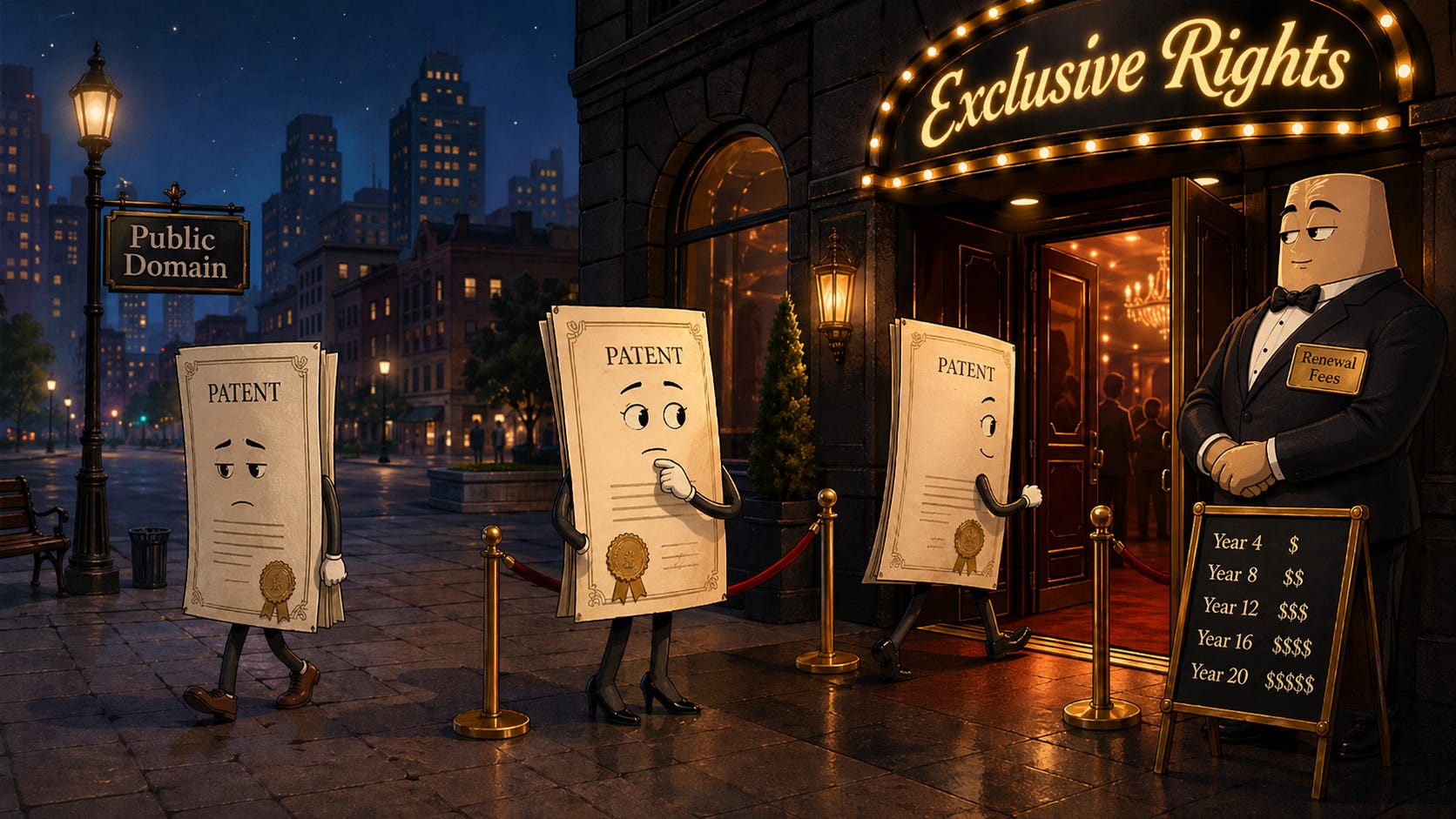
At the heart of fee design lies a basic tension: the patent system should be open enough to encourage entry and disclosure, but not so cheap that exclusion rights remain in force when their private value no longer justifies their social cost. Many major patent systems address this tension through back-loaded fee schedules: initial official fees are kept relatively modest, while renewal or maintenance fees rise over the life of the patent [5].
The economic logic of renewal fees is that they force patentees to reveal, periodically, whether a patent is still worth keeping alive. Ariel Pakes showed that the renewal decision can be understood as an option-like choice: each year, the owner decides whether the expected future value of the patent justifies paying the next renewal fee. Mark Schankerman and Ariel Pakes used this logic to infer the private value of patent rights from observed renewal behavior. A patent that is repeatedly renewed is not necessarily socially valuable, but it is valuable enough to its owner to justify the cost of continuation.
Renewal fees limit the duration of exclusion rights whose private value no longer justifies their cost. This public-domain function of renewal fees is well established, and several economists have modeled their optimal structure. Francesca Cornelli and Mark Schankerma, for example, show that optimal renewal fees should rise steeply with patent age, so that owners of highly valuable patents can buy longer protection while owners of lower-value patents are induced to let their rights lapse earlier. Marc Baudry and Béatrice Dumont (2006) make a related point: renewal fees can be designed as a mechanism for weeding out low-value patents. In this sense, the “renewal clerk” is as important to the public domain as the patent examiner is to the private one.
This logic also underlies more aggressive proposals for back-loaded fees. Jim Bessen and Brian Love propose “Pigouvian” renewal fees designed to induce the expiration of unused patents before they are acquired for nuisance-value litigation. A Pigouvian tax is a fee imposed to make private actors internalize the social costs they impose on others, as in the classic case of pollution. Applied to patents, the idea is to keep early fees low while raising late-stage maintenance fees steeply, forcing owners of older, unused patents either to justify their continued exclusionary rights or to let them fall into the public domain.
The same framework also highlights an institutional complication: the socially optimal fee schedule that economists devise need not be the revenue-maximizing one that the patent office may implement. Josh Gans and colleagues show that a self-funding patent office may have an incentive to flatten the fee schedule: raising application fees to collect revenue upfront while keeping renewal fees lower than socially optimal to encourage more patents to be kept alive. The result is a double distortion: some inventions may be deterred at entry, while too many exclusion rights may persist for too long. Fee design is, therefore, not only about steering applicants; it is also about ensuring that the institution setting the fees does not face incentives that push it away from social welfare.
The frontier: From cost recovery to behavioral pricing
Once fees are understood as behavioral instruments, the policy frontier becomes clearer. Existing fee schedules already use claim fees, IDS surcharges, late-continuation fees, and validation fees to discipline procedural complexity. More radical proposals push the same logic further, using fees not only to recover administrative costs but to reshape filing incentives, portfolio accumulation, and the stock of granted rights.
Neel Sukhatme, for example, notes that successful applicants typically pay more than unsuccessful ones and proposes higher fees for rejected applications to deter “lottery-ticket” filings. Another family targets the stock of granted patents. David Olson suggests scaling maintenance fees with the size of the owner’s portfolio, making very large portfolios more expensive to maintain and thereby discouraging the accumulation of anti-competitive patent thickets.
These ideas are not all equally feasible, and some move beyond ordinary patent-office cost recovery into quasi-taxation or litigation policy. But cost recovery should not be mistaken for social optimality. A fee schedule that balances the patent office’s books may still be too high at entry, too low at renewal, or poorly targeted across applicants and behaviors. Elsa Martin and Hubert Stahn push this point further, arguing that patent fees can be used as an innovation-policy instrument, not merely as a way to fund examination costs: in their model, fee revenues can be reallocated to universities to support research that expands the pool of freely available knowledge on which future patents build.
Conclusion: you are what you charge
Patent fees look like administrative charges, but they are really design choices. They decide who enters, who stays, who exits, and who pays for the system. The 2025 value-tax episode was a reminder that the price of patent protection is never neutral. A smart fee policy should not simply balance the books. It should ask what kind of patent system the fee schedule is quietly building: one that promotes entry, screens weak claims, releases unused rights, and preserves access—or one that merely maximizes revenue.
If you enjoy evidence-based takes on patents and innovation, join hundreds of readers who receive The Patentist directly in their inbox.
Please cite this post as follows:
de Rassenfosse, G. (2026). When patent fees become innovation policy. The Patentist Living Literature Review 12: 1–6. DOI: 10.2139/ssrn.6658140.
Taxes are, of course, a source of revenue for national and local governments, but they can also serve policy objectives by discouraging certain behaviors. In the same way, it is interesting to think of patent filing fees and renewal fees as part of patent policy—tools that can influence what kinds of patents applicants choose to pursue and maintain.