

Startups with patents tend to attract more investment and grow faster. But do patents help them succeed, or do the most promising startups simply have better inventions to patent? This distinction matters because observing that patent holders perform better does not prove that patents caused their success.
Ideally, researchers would compare otherwise identical startups, some with patents and others without. Such a design is common in clinical trials, where random assignment helps create comparable groups of patients and allows researchers to isolate the effect of a treatment. But patent offices cannot randomly grant or refuse applications simply to help economists answer a research question.
The luck of the draw
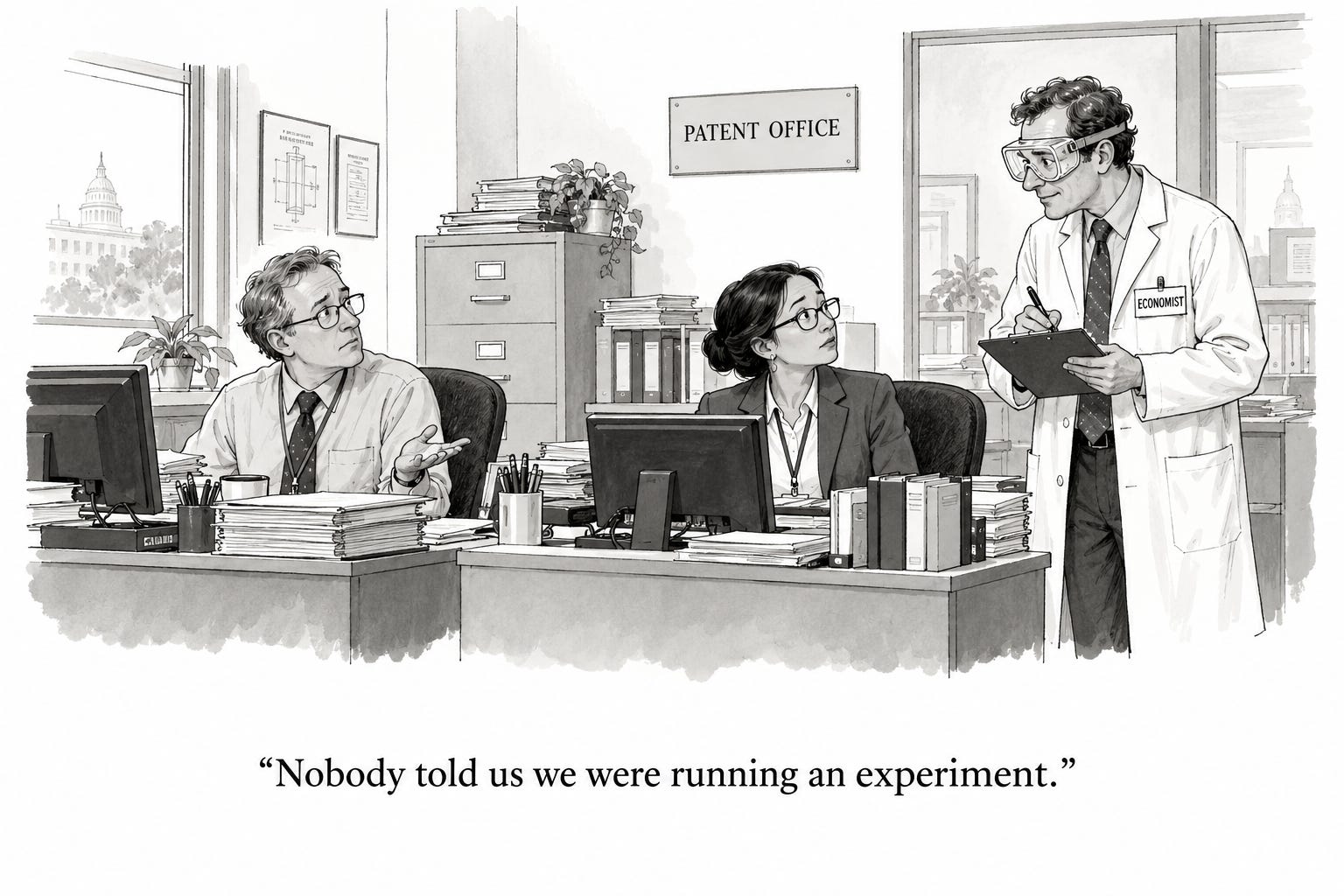
When deliberate randomization is not feasible, empirical researchers sometimes rely on the “luck of the draw.” The objective is to identify naturally occurring, “as good as random” variation in the administrative processes of the institution under study.
An influential example comes from criminal justice. Jeffrey Kling studied whether longer prison sentences affect employment and earnings after release. Simply comparing people who served different sentences would be misleading because their offenses and personal circumstances also differ. Instead, Kling exploited the assignment of cases to judges who differed in sentencing severity. In some courts, cases are assigned to judges at random so a defendant may draw a relatively strict or lenient judge by chance. Where that assignment was effectively random, it provided a way to study the consequences of longer imprisonment among otherwise comparable defendants.
As many patent offices as examiners
Patent examination offers a related opportunity. At the USPTO, examiners handling similar technologies can differ in their “leniency,” that is, their tendency to allow applications. If otherwise comparable applications reach these examiners largely by chance, those differences can help researchers study how receiving a patent changes an applicant’s outcome.
In this literature, “leniency” usually refers to an examiner’s tendency to allow applications relative to colleagues handling comparable cases. Differences in raw allowance rates between examiners are not sufficient to establish leniency: they may reflect the applications an examiner receives. Nor is a higher adjusted rate, by itself, evidence of poorer examination. It could also reflect differences in interpretation or in how effectively examiners help applicants reach allowable claims [1].
The literature begins with the paper by Iain Cockburn, Samuel Kortum, and Scott Stern, which documented substantial differences among patent examiners and explored how examiner characteristics related to patent characteristics and to court rulings on validity. Their research helped establish that examiner identity deserved attention when studying how patent rights are created and tested. As the authors memorably put it, “there may be as many patent offices as patent examiners.”
Early studies relied on accounts of how supervisors allocated applications within technology groups known as Art Units. Interviews reported by Mark Lemley and Bhaven Sampat described practices such as assigning applications based on the last digits of an application’s serial number or on examiner availability. These accounts suggested that, within a technology group and time period, an applicant might draw a stricter or more permissive examiner largely by chance. Whether this approximation holds is an empirical question, to which we return below.
What have we learned?
As explained, the key comparison is between applicants assigned to examiners with different tendencies to grant patents. Researchers typically measure those tendencies using examiners’ decisions on other applications. They then ask whether assignment to a more permissive examiner increases both the probability of obtaining a patent and a subsequent outcome, such as access to finance. Suppose otherwise comparable applicants assigned to more permissive examiners are more likely to obtain patents and to secure investment. If examiner assignment is effectively random and affects investment only through the patent grant, researchers can use those differences to estimate the effect of receiving a patent.
However, there is an important qualification: the resulting estimate applies to applications whose outcomes depend on which examiner reviews them. It does not necessarily describe inventions that almost every examiner would allow or applications that almost every examiner would reject. Put differently, the estimate applies to applications at the margin of the examination decision.
One influential finding concerns young companies. Joan Farre-Mensa, Deepak Hegde, and Alexander Ljungqvist estimate that securing a first patent increases startups’ employment growth by 55% and sales growth by 80% over the next five years. However, the benefits also vary across industries. Patrick Gaulé, studying venture-capital-backed startups, finds that patents increase the likelihood of a successful exit through an IPO or a high-value acquisition, but the effect is concentrated in the life sciences and among more important inventions.
Examiner differences can also help researchers investigate other aspects of the examination process: the time required to obtain a grant, the scope of the rights granted, and how applicants respond to setbacks. Deepak Hegde and colleagues find that delays in granting patents harm startups and their rivals, whereas broader patent scope benefits surviving startups but imposes costs on rivals’ growth and innovation. These results underscore that the consequences of examination cannot always be summarized by whether an application succeeds. They also underscore that benefits to patent recipients are only part of the policy picture. Assessing the patent system also requires understanding its effects on competitors, follow-on innovators, and consumers.
Some studies examine a different dimension of leniency: the extent to which examiners require applicants to revise their claims. Josh Feng and Xavier Jaravel find that patent assertion entities—businesses that acquire patents primarily to generate revenue through licensing and enforcement—disproportionately acquire and assert patents from examiners who require fewer changes during prosecution. Patents from these examiners are also more likely to be litigated and show more evidence of defects, as measured by requests to reissue granted patents.
This line of research has also shown how examination outcomes shape inventors’ behavior. Eduardo Melero, Neus Palomeras, and David Wehrheim estimate that obtaining a patent reduces an early-career inventor’s likelihood of changing employers by about 23%, consistent with patent protection increasing the value of staying with the current employer. Abhay Aneja and colleagues find that women applicants are less likely than men to continue after an early rejection, shedding light on the gender gap in patenting.
When does this research design work?
The approach is powerful, but its credibility depends on how applications are assigned to examiners. Applicants need not choose their examiner for the randomness condition to be violated: supervisors may direct particular technologies to particular specialists. Cesare Righi and Tim Simcoe found substantial technological specialization within Art Units. Applications assigned to the same examiner were more similar than random assignment would predict, and specialization persisted even within narrow technology subclasses. This pattern was less pronounced in computers and software than in several other fields.
This result matters because an examiner’s lower allowance rate might partly reflect the applications they receive. If those applications also differ in their commercial prospects, comparing applicants assigned to different examiners could confound the effect of patent protection with differences between the inventions themselves. The authors suggest that comparing cases within narrower technology groups can help, but it cannot automatically remove every relevant difference.
Administrative reforms can also affect the credibility of the design. Nick Pairolero and Charles deGrazia document a major change in October 2020, when the USPTO adopted an automated routing system designed to match new applications more closely to examiners’ technological expertise. In their sample, the reform increased examiners’ specialization, leading the authors to conclude that the earlier quasi-random assignment assumption no longer provided a credible basis for research under the new routing system.
However, this is not the final chapter. The authors note that the USPTO paused the CPC-based automated system in August 2022 in response to examiner feedback, and that subsequent changes could again alter assignment practices. The lesson is that researchers must determine how assignment worked during the period under study.
Looking forward
Related methods have also been used to study decisions made after patents are granted. Alberto Galasso and Mark Schankerman exploit the allocation of judges at the U.S. Court of Appeals for the Federal Circuit to study patent invalidation and follow-on innovation. Christiam Helmers and Brian Love use variation in administrative patent judge assignments to study how inter partes review affects the settlement of parallel litigation. Each institutional setting requires careful scrutiny of the assignment process and the decisions it influences.
Accidental experiments are not the only way forward. Patent offices can also deliberately run experiments in certain areas. For example, Nick Pairolero and colleagues study a USPTO randomized controlled trial in which applicants without legal representation were randomly assigned to receive additional examination assistance or to follow the regular process. The assistance improved applicants’ chances of obtaining a patent, with particularly strong benefits for teams of women inventors. Examiners helped applicants understand the process and identify allowable claims. This research provides a concrete example of how experimentation can inform administrative practice: it can evaluate better support for applicants while leaving the legal requirements for patentability in place.
Both accidental and deliberate experiments rely on detailed administrative records: who examined an application, what happened during prosecution, and how the process changed over time. Making these records available, transparent, and usable at scale is critical to enable researchers to test assumptions and estimate effects. The accidental laboratory works only when we can see how it operates.
If you enjoy evidence-based takes on patents and innovation, join hundreds of readers who receive The Patentist directly in their inbox.
Please cite this post as follows:
de Rassenfosse, G. (2026). Examiner leniency and the art of the accidental experiment. The Patentist Living Literature Review 16: 1–6. DOI: TBC.